If you’re preparing for a nicotine test, cutting back, or just curious about how your body processes it, the question comes up often: how long does nicotine actually stick around? The answer depends on more than just how much you use, since your body, your habits, and the type of test involved all play a role.
Nicotine itself clears from your bloodstream fairly quickly, but it leaves behind a byproduct called cotinine that lingers much longer and is what most tests actually detect. Understanding this distinction helps explain why timelines can vary so widely from person to person.
In this guide, you’ll learn how your body breaks nicotine down, what affects how fast it clears, and how long it’s detectable in different types of tests. We’ll also cover the withdrawal timeline, ways to support your body, and answers to common questions. Let’s get into the details.
Understanding Nicotine and Cotinine
Before diving into timelines, it helps to understand what’s actually happening in your body. Nicotine is a stimulant compound found in tobacco products, vapes, and nicotine replacement products such as patches and gum. Once it enters your bloodstream, if through smoking, vaping, chewing, or absorption through the skin, your liver begins breaking it down almost immediately.
The liver converts most nicotine into a metabolite called cotinine. This is an important distinction, because:
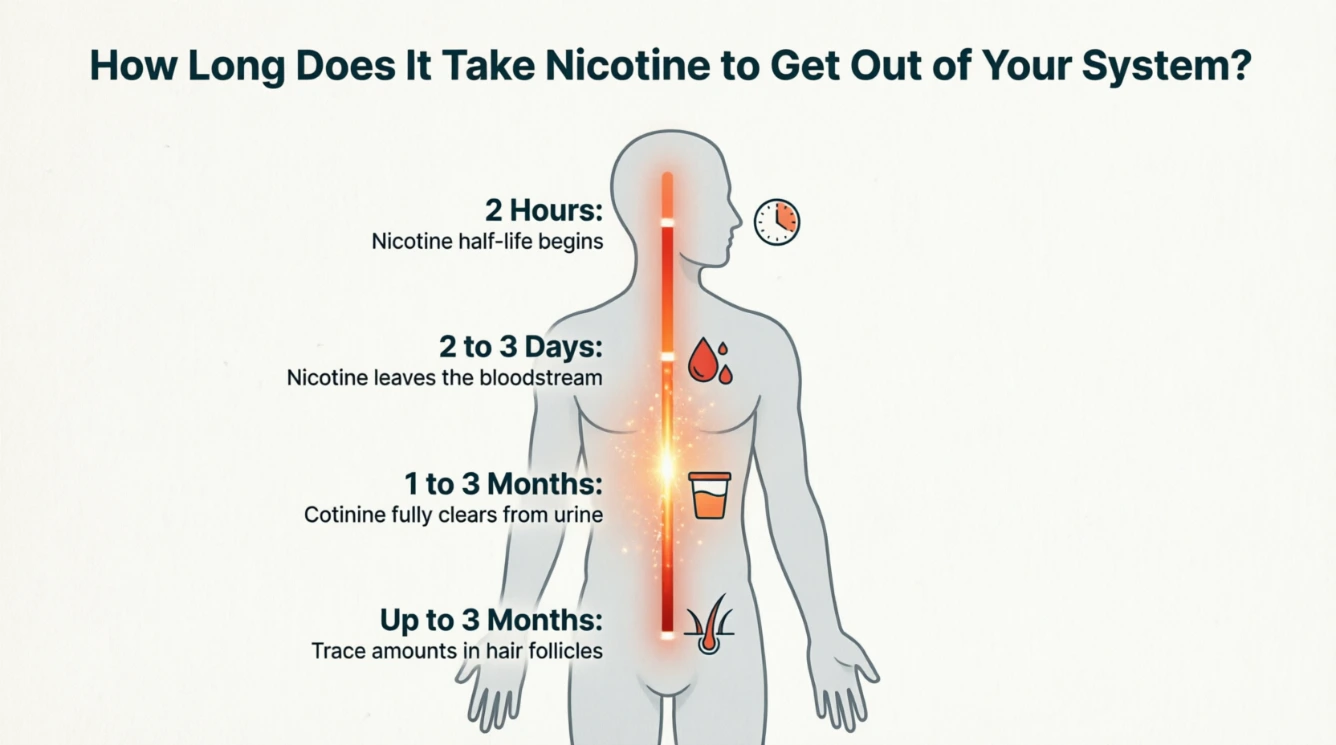
- Nicotine has a short half-life, typically around 1 to 2 hours, meaning it clears from your blood relatively fast.
- Cotinine has a much longer half-life, generally 16 to 24 hours, which means it stays detectable for days after your last use.
This is why most nicotine tests, including workplace and insurance screenings, actually measure cotinine rather than nicotine itself. Cotinine acts as a reliable marker because it lingers long enough to reflect recent use, even after nicotine itself has left your bloodstream.
Other minor metabolites also form during this process, but cotinine remains the primary one used for testing and research. Understanding this two-step breakdown, nicotine into cotinine, and cotinine slowly clearing afterward, is the foundation for everything else in this guide.
The Science of Elimination
Nicotine metabolism follows a predictable pattern, but the exact speed varies from person to person. Here’s what’s happening physiologically.
Absorption. However nicotine enters your body, it reaches your bloodstream quickly, often within seconds when inhaled and within minutes when absorbed through the skin or mouth.
Metabolism. Your liver processes nicotine through an enzyme system, converting roughly 70 to 80 percent of it into cotinine. The remaining nicotine is either excreted unchanged or converted into smaller amounts of other metabolites.
Half-life. A substance’s half-life is the time it takes for half of it to clear from your bloodstream. Nicotine’s short half-life means it drops quickly, while cotinine’s longer half-life means it takes several days to fully clear.
Full clearance. As a rough guide, a substance is generally considered mostly cleared after about five half-lives. For nicotine, that’s roughly 5 to 10 hours. For cotinine, that stretches to about 3 to 5 days for light users, though it can take longer for regular or heavy users.
Why heavier use extends the timeline. Frequent use leads to a buildup of cotinine in fatty tissue and other body stores, which slowly releases back into the bloodstream. This is why long-term smokers or vapers often test positive for longer than occasional users.
Understanding this half-life pattern explains why the answer to “how long does nicotine stay in your system” is never a single fixed number.
Factors That Affect Your Timeline
Several personal and lifestyle factors influence how quickly nicotine and cotinine clear from your system, which is why two people can have very different results.
Frequency and amount of use. Someone who smokes a pack a day will typically clear nicotine and cotinine more slowly than an occasional social smoker, due to the buildup in body tissues.
Metabolism. Individual metabolic rate, influenced by genetics, age, and liver function, affects how quickly your body processes nicotine.
Body composition. Because cotinine can be stored in fatty tissue, body composition can influence how long traces remain detectable.
Hydration and kidney function. Since some nicotine and its metabolites are excreted through urine, hydration and healthy kidney function can support elimination.
Type of nicotine product. Vaping, smoking, chewing tobacco, and nicotine replacement therapy all deliver nicotine differently, which can subtly affect absorption and clearance rates.
Genetics. Some people have naturally faster or slower nicotine-metabolizing enzymes, which can shift individual timelines even under similar usage patterns.
Overall health. Liver or kidney conditions can slow the breakdown and clearance of nicotine and cotinine.
Because so many factors are involved, general timelines are estimates rather than guarantees for any one person.
Detection Windows by Test Type
Different tests look for nicotine or cotinine in different parts of the body, and each has its own detection window.
Blood Tests
Blood tests can detect nicotine for about 1 to 3 days after use, and cotinine for up to 10 days, though this window shortens for occasional users and lengthens for regular ones.
Urine Tests
Urine testing is the most common method, since cotinine concentrates well in urine. It typically detects use for 3 to 4 days in light users, and up to several weeks in heavy, long-term users.
Saliva Tests
Saliva tests are convenient and often used for quick screening. Cotinine is generally detectable in saliva for about 1 to 4 days, depending on usage patterns.
Hair Tests
Hair testing offers the longest detection window by far, since nicotine and cotinine become embedded in the hair shaft as it grows. These tests can potentially detect use for up to 90 days or longer, though they’re used less frequently than other methods.
A Quick Comparison
- Blood: short-term window, a few days
- Urine: the most common test, typically 3 to 4 days for light users
- Saliva: short-term window, similar to blood
- Hair: long-term window, up to several months
Knowing which test you’re facing can help set realistic expectations for detection timelines.
Ways to Support Your Body’s Natural Process
While there’s no way to instantly eliminate nicotine or cotinine from your system, certain habits can support your body’s natural detox process.
Stay hydrated. Drinking plenty of water supports kidney function and helps your body flush out water-soluble metabolites through urine.
Eat a balanced diet. Fruits, vegetables, and whole foods support overall liver function, which plays a central role in metabolizing nicotine.
Get physical activity. Exercise supports circulation and metabolism, which may help your body process substances more efficiently over time.
Get enough sleep. Your liver does much of its metabolic work during rest, so good sleep supports overall detoxification processes.
Stop use as early as possible. The most effective way to reduce nicotine and cotinine levels is simply to stop using nicotine products, since ongoing use continually replenishes what your body is trying to clear.
Be patient. No supplement or shortcut can override your body’s natural elimination timeline. Consistency in healthy habits matters more than any single quick fix.
Common Myths and Methods to Avoid
Because nicotine testing can carry high stakes, plenty of myths circulate about ways to speed up clearance. Most don’t hold up.
Myth: Detox drinks flush out nicotine instantly. These products may dilute urine temporarily, but they don’t actually remove cotinine from your system, and heavily diluted samples can sometimes be flagged by testing labs.
Myth: Excessive water intake eliminates nicotine in hours. While hydration supports normal kidney function, drinking excessive amounts in a short time won’t meaningfully accelerate cotinine clearance and can even be unsafe.
Myth: Cranberry juice or certain foods detox your system. No specific food has been shown to significantly speed up nicotine metabolism.
Myth: Secondhand exposure doesn’t affect test results. Regular, heavy exposure to secondhand smoke can occasionally register on sensitive tests, though this is far less common than direct use.
What to avoid. Don’t rely on unverified detox kits or extreme water-loading, since these approaches are unreliable and can pose their own risks. The safest and most effective approach is simply time, hydration, and stopping use.
Withdrawal Timeline After Quitting
Many people asking about nicotine clearance are also curious about what to expect after quitting. While everyone’s experience differs, general patterns include the following.
First 24 hours. Nicotine levels drop quickly, and early withdrawal symptoms such as irritability or cravings can begin.
Days 2 to 3. Nicotine is largely cleared from the bloodstream, though cotinine remains detectable. This period often brings the most intense cravings and physical symptoms.
Week 1 to 2. Symptoms such as irritability, difficulty concentrating, and cravings typically start to ease, though they can still appear periodically.
Weeks 3 to 4. Many people notice improved mood stability and fewer cravings, though occasional urges are still common.
Beyond one month. Physical withdrawal symptoms generally fade, though psychological habits and situational cravings can persist longer for some people.
If withdrawal symptoms feel overwhelming, a doctor or a smoking cessation program can offer guidance and support tailored to your situation.
FAQs
How long does nicotine stay in your system after one cigarette?
Nicotine itself typically clears within about a day, while cotinine may remain detectable for a few days.
Does vaping clear faster than smoking?
The nicotine and cotinine clearance process is similar regardless of delivery method, though total nicotine intake can vary between vaping and smoking.
Can secondhand smoke cause a positive test?
Heavy, prolonged exposure can occasionally result in low-level detection, though it’s much less likely than direct use.
Does drinking more water really help?
Staying hydrated supports normal kidney function, but it won’t dramatically speed up clearance beyond your body’s natural pace.
How long until a test comes back clean?
This depends heavily on the test type and your usage history, ranging from a few days for blood or saliva tests to several weeks or more for regular users on a urine test, and even longer for hair tests.
Is quitting the only way to guarantee a clean test?
Yes. Since ongoing use continually replenishes cotinine levels, stopping use is the most reliable way to clear your system over time.
Conclusion
Nicotine leaves your bloodstream relatively quickly, but its metabolite, cotinine, lingers much longer and is what most tests actually detect. The exact timeline depends on how much and how often you use nicotine, your individual metabolism, and the type of test involved.
Remember the key points: nicotine clears in hours, cotinine clears over days, and heavier or longer-term use extends both timelines. Supporting your body with hydration, good nutrition, and rest can help, but there’s no true shortcut around your body’s natural pace.
If you’re working toward quitting, know that the most intense symptoms typically ease within a few weeks, and support is available if you need it.
If you found this guide helpful, share it with someone who might be wondering the same thing, and subscribe for more health and wellness explainers.

I am Owen Walker, the author of dreamzoons.com and a passionate dream expert. I explore the hidden secrets and deep meanings of dreams to help you understand the true messages behind them.