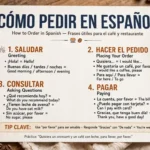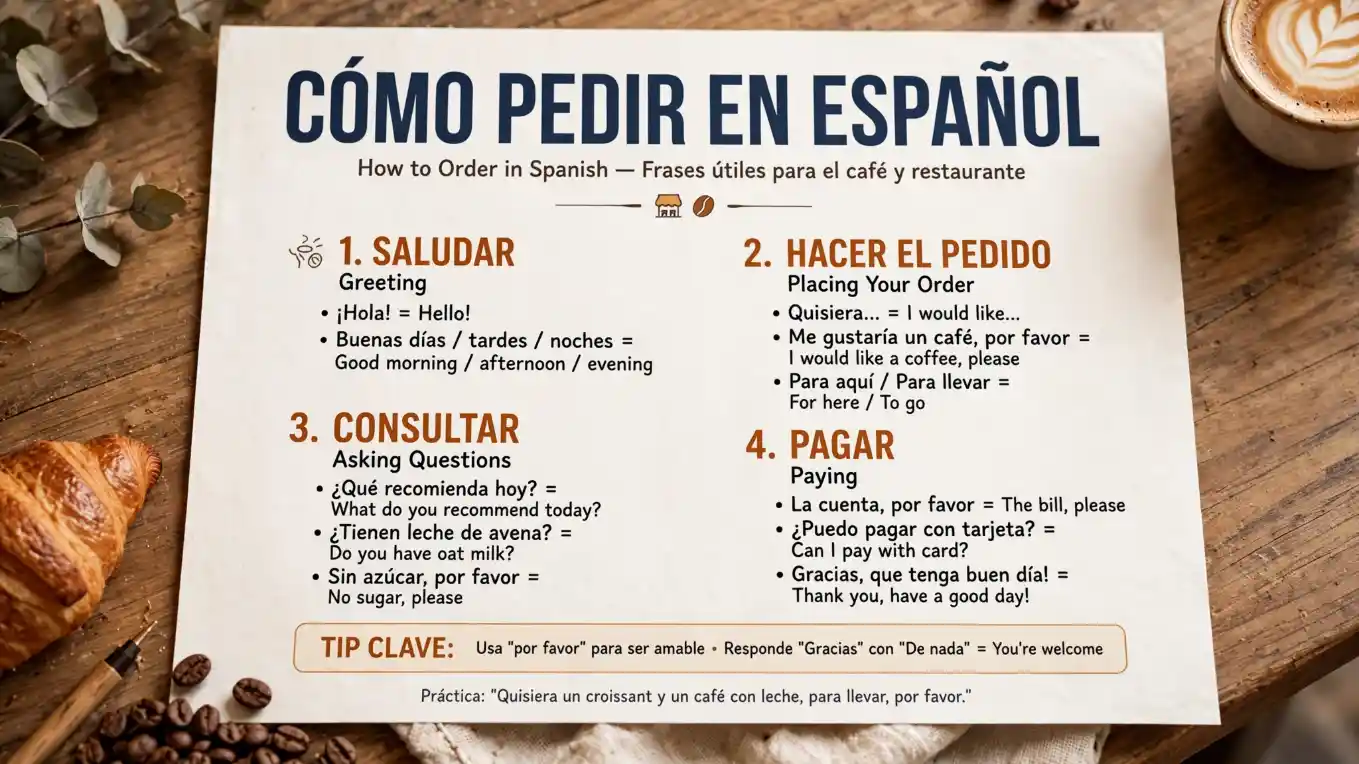
To order in Spanish, use simple phrases such as “Quisiera…” (I would like…), “Me gustaría…” (I would like…), or “Para mí…” (For me…). Add “por favor” to sound polite. At a restaurant, you can also ask “¿Qué me recomienda?” (What do you recommend?) and “La cuenta, por favor” (The check, please).
Key Takeaways
- Quisiera… is a polite and useful way to start an order.
- Pedir commonly means “to ask for” or “to order.”
- ¿Qué me recomienda? means “What do you recommend?”
- Use sin + ingredient to request something without an ingredient.
- La cuenta, por favor means “The check, please.”
- Spanish restaurant vocabulary can vary somewhat between Spain and Latin America.
The Most Useful Spanish Phrases for Ordering
You do not need to speak perfect Spanish to order a meal. A few short phrases can take you from the menu to the table with much more confidence.
The easiest starting point is “Quisiera…”, which means “I would like…” You can put the food or drink you want after it.
For example:
- Quisiera una hamburguesa, por favor. : I would like a hamburger, please.
- Quisiera un café, por favor. : I would like a coffee, please.
- Quisiera una ensalada. :I would like a salad.
You can also use “Me gustaría…”, meaning “I would like…” This sounds polite and works well when making a request.
How to Say “I’d Like” in Spanish
The two phrases worth remembering first are:
| Spanish | English |
| Quisiera… | I would like… |
| Me gustaría… | I would like… |
| Para mí… | For me… |
| Voy a pedir… | I’m going to order… |
For example, if you are eating with friends, “Para mí, el pollo” clearly tells the server which meal you want.
How to Say “Can I Have?” in Spanish
There are several natural ways to ask for something.
¿Me puede traer…? means “Can you bring me…?”
¿Puedo pedir…? Means “Can I order…?”
For example:
¿Me puede traer un vaso de agua, por favor?
Can you bring me a glass of water, please?
These request forms are especially useful because they let you order without needing a complicated sentence.
How to Order Food at a Spanish Restaurant
Ordering becomes much easier when you think of it as a short sequence.
Step 1: Greet the Server
Start with a simple greeting:
- Hola. — Hello.
- Buenos días. — Good morning.
- Buenas tardes. — Good afternoon.
- Buenas noches. — Good evening.
Then use por favor when making a request.
Step 2: Ask for the Menu
You can say:
¿Me puede traer el menú, por favor?
Can you bring me the menu, please?
In Spain, you will also hear la carta for the menu, especially when referring to the regular à la carte menu. Menú del día usually refers to a set daily meal rather than simply the restaurant’s menu.
So in Spain, you might say:
¿Me puede traer la carta, por favor?
Can you bring me the menu, please?
Step 3: Place Your Order
When the server asks if you are ready, you can use one of these:
Quisiera la sopa, por favor.
I would like the soup, please.
Me gustaría el pollo con arroz.
I would like the chicken with rice.
Para mí, una ensalada.
For me, a salad.
You may also hear ¿Qué desea? or ¿Qué van a pedir?, which roughly means “What would you like?” and “What are you going to order?”
Step 4: Ask Questions About the Food
Don’t be afraid to ask questions before ordering.
¿Qué me recomienda?
What do you recommend?
¿Qué lleva este plato?
What does this dish contain?
¿Es picante?
Is it spicy?
¿Qué incluye?
What does it include?
¿Cuál es el plato del día?
What is the dish of the day?
These questions are useful when the menu contains unfamiliar foods.
Step 5: Request Changes
Need to leave something out? The easiest structure is sin + ingredient, meaning “without + ingredient.”
Sin cebolla, por favor.
Without onion, please.
Lo quiero sin queso.
I want it without cheese.
Sin picante, por favor.
No spicy food, please.
You can also explain an allergy:
Soy alérgico a los frutos secos. — I am allergic to nuts.
Soy alérgica a los frutos secos. — I am allergic to nuts.
Your choice between alérgico and alérgica depends on the speaker’s gender.
Step 6: Ask for the Bill
When you finish eating, simply say:
La cuenta, por favor.
The check, please.
For a more complete request:
¿Me puede traer la cuenta, por favor?
Can you bring me the check, please?
This is one of the most useful phrases to memorize before eating at a Spanish-speaking restaurant.
Pedir vs. Ordenar: What Is the Difference?
This can confuse English speakers.
The verb pedir commonly means “to ask for,” “to request,” or “to order.” It is extremely useful when talking about ordering food.
For example:
Voy a pedir tacos.
I am going to order tacos.
¿Qué vas a pedir?
What are you going to order?
You may also hear ordenar in some Spanish-speaking regions and restaurant contexts. Both can refer to ordering, but pedir is a particularly useful and widely understood choice for learners.
One important point: orden can also mean an “order” in the sense of an instruction or command, so context matters. Meanwhile, pedido can refer to an order that has been placed, especially for goods or services.
For a beginner, remembering pedir = to ask for/to order is a great place to start.
Useful Spanish Restaurant Phrases
Here is a quick cheat sheet you can save:
| Spanish phrase | English meaning |
| Quisiera… | I would like… |
| Me gustaría… | I would like… |
| Para mí… | For me… |
| ¿Qué me recomienda? | What do you recommend? |
| ¿Qué lleva? | What does it contain? |
| ¿Es picante? | Is it spicy? |
| Sin cebolla, por favor. | Without onion, please. |
| ¿Tienen opciones vegetarianas? | Do you have vegetarian options? |
| La cuenta, por favor. | The check, please. |
| Muchas gracias. | Thank you very much. |
You can get through many restaurant situations with these phrases alone.
How to Order Drinks and Takeout
Ordering drinks follows the same simple pattern.
Quisiera un agua, por favor.
I would like some water, please.
Para mí, un café.
A coffee for me.
¿Qué bebidas tienen?
What drinks do you have?
If you want food to go, learn para llevar, which means “to go” or “takeout.”
For example:
Es para llevar, por favor.
It’s to go, please.
Quisiera pedir para llevar.
I would like to order to go.
This expression is especially useful at cafés, restaurants, food counters, and other casual places.
Simple Spanish Restaurant Dialogue
Here is a short conversation you can practice:
Server: Hola, ¿qué desean?
Customer: Hola. Quisiera una sopa y un pollo con arroz, por favor.
Server: ¿Qué quieren para beber?
Customer: Para mí, un agua, por favor.
Server: ¿Algo más?
Customer: No, gracias.
Server: Muy bien.
Customer: La cuenta, por favor.
English:
Server: Hello, what would you like?
Customer: Hello. I would like soup and chicken with rice, please.
Server: What would you like to drink?
Customer: Water for me, please.
Server: Anything else?
Customer: No, thank you.
Server: Very good.
Customer: The check, please.
Practice this dialogue aloud a few times. Once the pattern feels familiar, replace the food and drinks with your own choices.
Common Mistakes to Avoid
One common beginner mistake is trying to translate English word-for-word. Spanish often uses a different sentence structure, so memorizing useful phrases is easier than translating every sentence in your head.
Another mistake is forgetting por favor and gracias. Your Spanish does not need to be perfect to be polite.
Also, don’t worry if you hear different expressions in different countries. Spanish is spoken across many countries, and restaurant vocabulary and customs can vary. For example, pedir is widely useful, while particular ordering expressions may sound more common in one region than another.
Most importantly, speak slowly and clearly. A simple sentence that you feel comfortable saying is more useful than a complicated sentence you cannot remember.
FAQs About Ordering in Spanish
How do you say “I would like to order” in Spanish?
You can say “Quisiera pedir, por favor” or “Me gustaría pedir, por favor.” Both communicate “I would like to order, please.” You can then name the food or drink you want, such as “Quisiera pedir una ensalada.”
What is the Spanish word for “to order”?
The most useful word for beginners is pedir, which can mean “to ask for,” “to request,” or “to order.” For example, “Voy a pedir pizza” means “I’m going to order pizza.” You may also encounter ordenar, depending on the country and context.
How do you politely order food in Spanish?
Use “Quisiera…”, “Me gustaría…”, or “¿Me puede traer…?” followed by the food or drink. Adding “por favor” makes the request polite. For example, “Quisiera un café, por favor.” means “I would like a coffee, please.”
How do you ask for the check in Spanish?
Say “La cuenta, por favor” for “The check, please.” You can also say “¿Me puede traer la cuenta, por favor?”, meaning “Can you bring me the check, please?” Both are useful at restaurants.
Conclusion
Learning how to order in Spanish does not require advanced Spanish. Start with a few practical phrases: Quisiera…, Me gustaría…, Para mí…, ¿Qué me recomienda?, and La cuenta, por favor.
Remember that pedir is an especially useful verb for ordering food. With these expressions, you can ask for a menu, choose a meal, request changes, order drinks, ask questions, and pay with much more confidence.
The best way to learn is to practice short sentences aloud. Once these phrases become familiar, ordering at a Spanish-speaking restaurant will feel much easier and more natural.

I am Owen Walker, the author of dreamzoons.com and a passionate dream expert. I explore the hidden secrets and deep meanings of dreams to help you understand the true messages behind them.