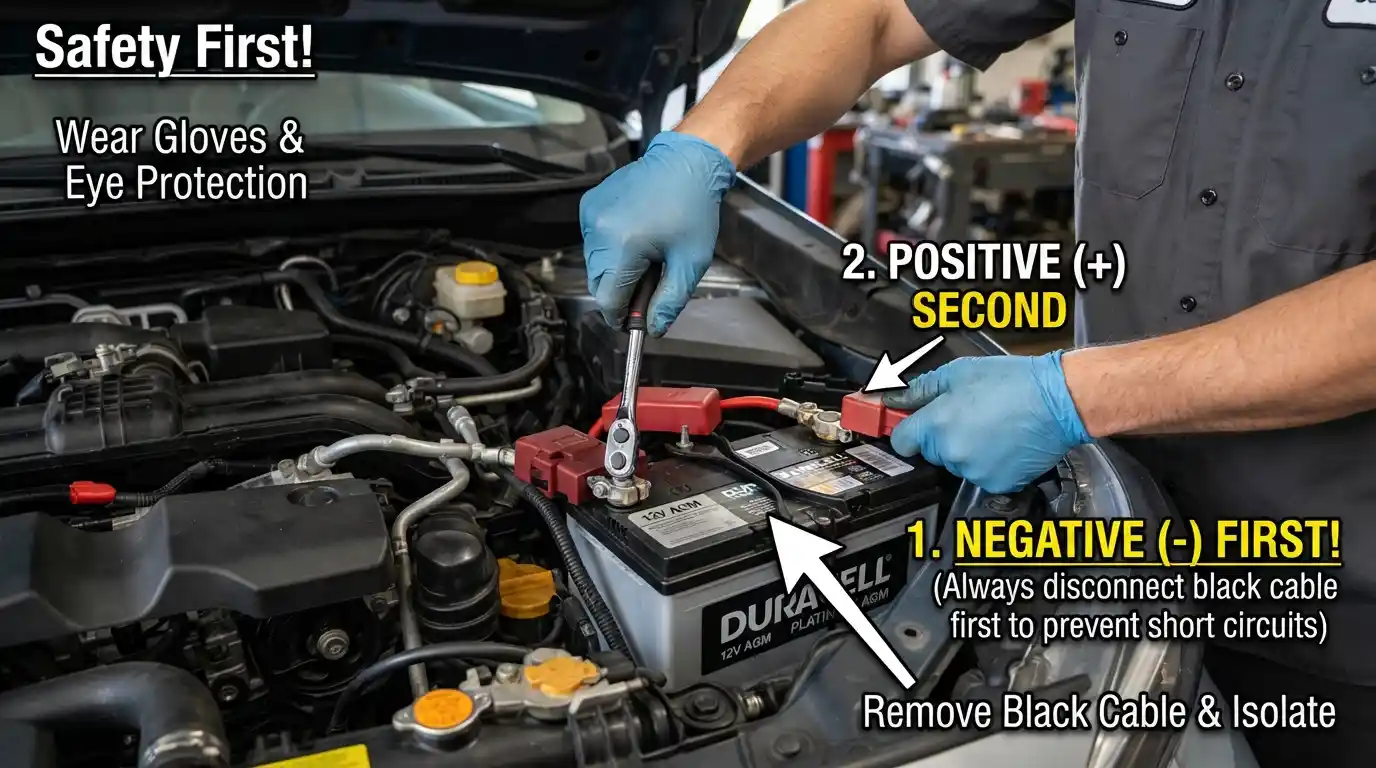
To disconnect a car battery safely, turn off the vehicle and remove the negative (-) terminal first, followed by the positive (+) terminal. Keep the loose cables away from the battery posts. If you reconnect the battery, reverse the order: connect the positive terminal first, then the negative terminal.
Key Takeaways
- Always disconnect the negative terminal first.
- Remove the positive terminal only after the negative cable is safely out of the way.
- Use the correct-size wrench or socket and wear eye protection.
- Reconnect the battery in the opposite order: positive first, negative second.
- Check your owner’s manual because battery locations and procedures vary by vehicle.
What You Need Before Disconnecting a Car Battery
Disconnecting a typical 12-volt car battery is a fairly simple job, but safety matters.
Before you start, gather:
- A correctly sized wrench or socket
- Safety glasses
- Protective gloves
- A flashlight if the battery is difficult to reach
- A small cover or insulating material for a disconnected cable
Park the vehicle on a level surface. Put the transmission in Park if it has an automatic transmission, or in gear if appropriate for a manual transmission. Apply the parking brake.
Turn the engine off completely and remove the key or key fob from the vehicle. Make sure the headlights, interior lights, radio, and other electrical accessories are switched off.
Your owner’s manual is also worth checking before you begin. Some vehicles place the battery in the trunk, beneath a seat, or behind a cover rather than directly under the hood.
Which Battery Terminal Should You Disconnect First?
Disconnect the negative (-) terminal first, then the positive (+) terminal.
The negative terminal is usually marked with a minus (-) sign and commonly has a black cable. The positive terminal has a plus (+) sign and is commonly associated with a red cable. Always rely on the markings rather than color alone.
Why the Negative Terminal Comes Off First
The negative side of a conventional vehicle battery connects to the vehicle’s electrical ground. Removing it first reduces the chance of creating a short circuit if your metal tool accidentally touches another metal part of the vehicle while working around the positive terminal.
For example, if you loosen the positive terminal while the negative connection remains attached and your metal wrench touches the vehicle’s metal body, you can create an unwanted electrical path. Removing the negative connection first greatly reduces this risk.
That’s why the simple rule is:
Disconnect: Negative → Positive
Reconnect: Positive → Negative
How to Disconnect a Car Battery Step by Step
1. Turn Off the Vehicle
Make sure the engine is off and the ignition is completely switched off. Remove the key.
Turn off electrical accessories such as:
- Headlights
- Radio
- Climate controls
- Interior lights
- Chargers and accessories
Give the vehicle a moment to shut down its normal electrical systems before touching the battery.
2. Locate the Battery
Open the hood and locate the battery.
Many vehicles have the battery in the engine compartment, but some place it in the trunk or another enclosed area. If you cannot find it, check your owner’s manual rather than guessing. Some vehicles also provide remote terminals under the hood.
Before touching anything, look for the + and – markings on the battery.
3. Identify the Negative Terminal
Find the terminal marked –.
It is commonly connected to a black cable, although cable colors can vary. The marking on the battery is the best way to identify it.
Do not assume that the terminal closest to you is the negative one. Take a moment to confirm the marking.
4. Disconnect the Negative Cable
Place the correctly sized wrench or socket on the fastener holding the negative cable to the battery post.
Loosen the fastener enough to release the cable clamp. You normally do not need to remove the fastener completely.
Once the clamp is loose, lift it away from the battery post.
Keep the cable away from the battery terminal so it cannot accidentally spring back into contact. Interstate Batteries also recommends keeping the disconnected cables from accidentally touching the battery or metal components.
5. Disconnect the Positive Cable
Now move to the positive terminal marked +.
Loosen its fastener and lift the cable clamp from the battery post.
Keep this cable safely away from the battery and other metal components.
At this point, both battery connections are disconnected.
If you are only cutting power to the vehicle for a specific maintenance task, you may not need to remove the battery from its tray.
6. Remove the Battery if Necessary
If you’re replacing the battery, you will also need to remove the battery hold-down bracket, strap, or clamp.
Make sure both terminals are disconnected before removing the hold-down hardware.
Car batteries can be heavy, so use both hands and lift carefully. Keep the battery level while carrying it.
If the battery has significant damage, leakage, swelling, or other unusual signs, stop and seek professional assistance rather than continuing with the removal.
How to Reconnect a Car Battery
Reconnecting the battery is essentially the reverse of disconnecting it.
Follow this order:
- Place the battery securely in its tray.
- Install and tighten the battery hold-down.
- Connect the positive (+) cable first.
- Tighten the positive terminal so it is secure.
- Connect the negative (-) cable second.
- Tighten the negative terminal securely.
- Check that neither cable can move or come loose.
The positive-first, negative-second sequence is recommended when reinstalling a conventional car battery.
Do not overtighten the terminal fasteners. A secure connection is important, but excessive force can damage components.
What Happens After You Disconnect a Car Battery?
Disconnecting a battery cuts electrical power to many of the vehicle’s systems.
Depending on the vehicle, you may lose things such as:
- Clock settings
- Radio presets
- Certain stored preferences
- Some learned vehicle settings
Modern vehicles can also need time to relearn certain settings after power is restored. AAA notes that disconnecting a modern vehicle battery can erase some memory settings and may require the vehicle to relearn certain driveability settings.
Some vehicles may require additional procedures after battery replacement. For that reason, check the owner’s manual for your specific make and model.
A memory-saving device may help preserve certain settings during battery replacement, but if you can use one—and where it should connect—depends on the vehicle.
Common Mistakes to Avoid
Disconnecting the Positive Terminal First
This is one of the most common mistakes. For a conventional vehicle, remove the negative terminal first.
Reconnecting in the Same Order
Remember that reconnection is the reverse:
Positive first, negative second.
Letting a Loose Cable Touch the Terminal
After removing a cable, keep it positioned away from its battery post. An unsecured cable can accidentally make contact again.
Using the Wrong Tool
A poorly fitting wrench can slip and cause damage or injury. Use the correct size for the terminal fastener.
Working Without Eye Protection
Battery work can involve sparks and corrosive materials. Safety glasses are a sensible precaution.
Assuming Every Vehicle Uses the Same Procedure
Modern vehicles can have different battery locations, electrical systems, and manufacturer-specific procedures. Always check the owner’s manual when you’re unsure.
When You Should Not Disconnect the Battery Yourself
A conventional 12-volt battery is one thing, but hybrid and electric vehicles are different.
Do not treat a high-voltage hybrid or EV battery like a normal 12-volt car battery. These vehicles can contain high-voltage systems that require specialized procedures and equipment.
If you’re working on a hybrid or electric vehicle, follow the manufacturer’s service instructions or use a qualified technician.
You should also consider professional help if the battery is damaged, leaking, badly swollen, difficult to access, or connected to a system you do not understand.
For newer vehicles, disconnecting the battery can also affect electronic settings and systems, so the owner’s manual should be your first reference for model-specific instructions.
Frequently Asked Questions
Which battery terminal do I disconnect first?
Disconnect the negative (-) terminal first, followed by the positive (+) terminal. This order reduces the risk of accidentally creating a short circuit with a metal tool. When reconnecting the battery, reverse the sequence: positive first, then negative.
Is it positive or negative first when disconnecting a car battery?
It is negative first when disconnecting a conventional car battery. Look for the minus (-) marking to identify the negative terminal. After removing it, disconnect the positive (+) terminal.
What happens if I disconnect the positive terminal first?
Disconnecting the positive terminal first increases the risk of a short circuit if your metal tool touches the vehicle’s grounded metal body. That’s why standard battery-removal guidance recommends removing the negative terminal first.
Do I need to disconnect both terminals?
If you want to completely disconnect a conventional car battery from the vehicle, you generally remove both terminals. If your goal is only to reduce electrical drain, the correct procedure depends on the vehicle and the reason for disconnecting it.
Will disconnecting my car battery reset the computer?
It can reset or erase some stored settings, such as radio presets or clock settings, and some vehicles may need to relearn certain operating parameters. The exact effect varies by vehicle.
How do I reconnect a car battery?
Reconnect the battery in the reverse order of removal. Connect the positive (+) terminal first, then connect the negative (-) terminal. Make sure both connections are secure before starting the vehicle.
Final Thoughts
Learning how to disconnect a car battery is simple once you remember one important rule: negative first, positive second. Turn the vehicle off, identify the terminals carefully, remove the negative cable, then remove the positive cable. Keep the disconnected cables away from the battery posts and other metal parts.
When you’re ready to reconnect the battery, reverse the process: positive first, negative second.
For a standard 12-volt vehicle, these steps can make basic battery maintenance much easier. However, always check your owner’s manual for model-specific instructions, especially with newer vehicles, hybrids, and EVs.

I am Owen Walker, the author of dreamzoons.com and a passionate dream expert. I explore the hidden secrets and deep meanings of dreams to help you understand the true messages behind them.