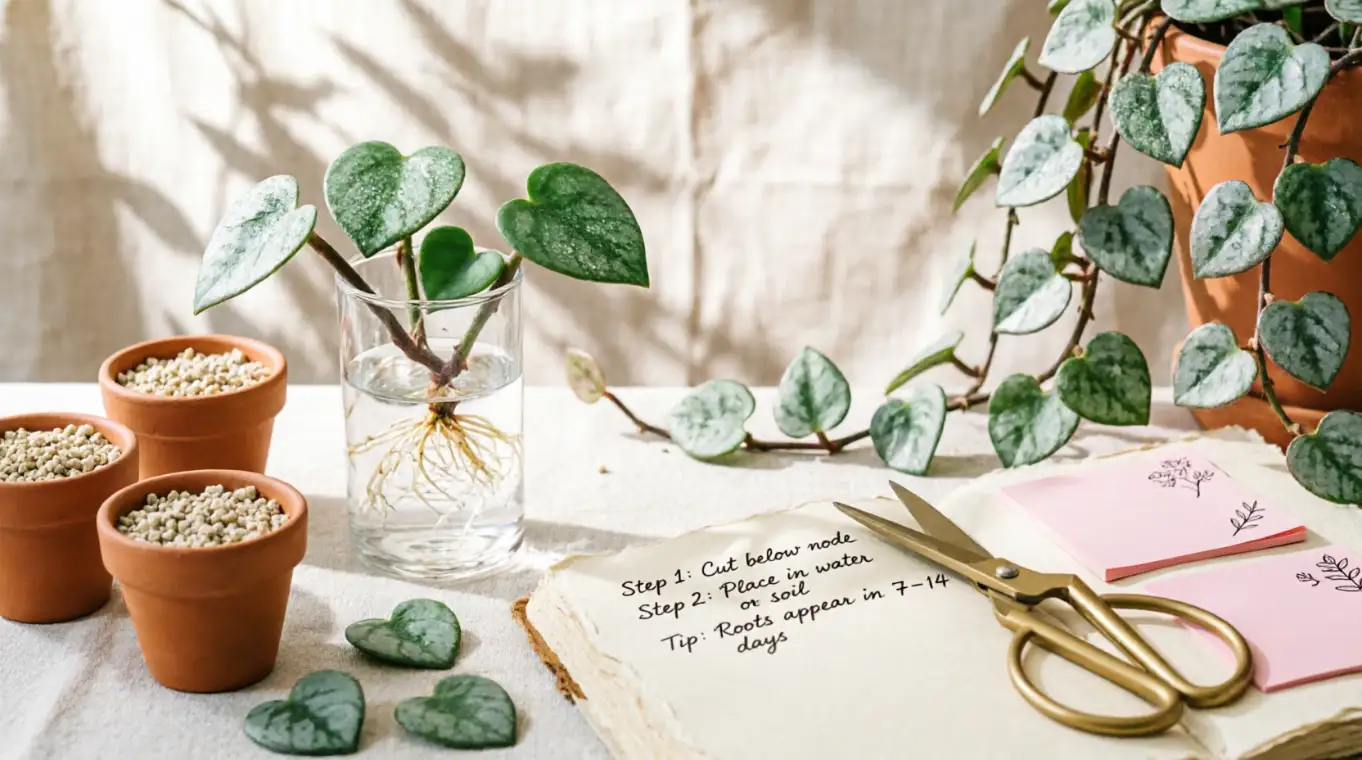
String of hearts, with its cascading vines of heart-shaped leaves, is one of the most rewarding houseplants to propagate. A single healthy plant can produce dozens of new starts, making it easy to fill more pots, share with friends, or simply make your existing plant look fuller.
The best part is how forgiving this plant is. Its trailing stems often grow small nodes and even tiny tubers along their length, and each one holds the potential for a brand-new plant. if you root cuttings in water, tuck them into soil, or grow tubers directly, the process takes only a few simple supplies and a bit of patience.
In this guide, you’ll learn how the string of hearts propagates, how to take a healthy cutting, and how to root it step by step. We’ll also cover different methods, ways to speed things up, aftercare, and fixes for common problems. Grab your shears and let’s get started.
Understanding String of Hearts
Before you start snipping, it helps to know what makes this plant unique. String of hearts (Ceropegia woodii), sometimes called rosary vine or chain of hearts, is a trailing succulent-like plant native to South Africa and parts of Zimbabwe and Eswatini. It belongs to the same family as milkweed and hoya, which explains its resilient, low-maintenance nature.
Its most distinctive feature is the small, potato-like tubers that form along the vine, especially at the leaf nodes. In the wild, these tubers help the plant survive dry seasons by storing water and energy. For propagation, they’re a huge advantage, since a tuber can often root and grow into a full plant even faster than a plain cutting.
The leaves themselves are heart-shaped, usually marbled with silvery-green and purple patterns, and grow in opposite pairs along thin, wiry stems. Under bright light, the vines can develop a deep purple hue on the undersides.
Understanding these features helps explain why propagation works so well:
- Nodes are the points where leaves attach, and they contain the cells needed to grow new roots.
- Tubers are natural storage structures that can root on their own with minimal help.
- Trailing stems naturally touch the soil in the wild, which is how the plant spreads and forms new tubers.
With this in mind, you can see why nearly any healthy section of vine has the potential to become a new plant.
The Basics of Successful Propagation
Propagating a string of hearts comes down to encouraging a stem or tuber to grow roots, and a few core principles make that far more reliable.
Choose healthy growth. A cutting can only grow as well as the parent tissue it comes from. Look for firm, plump leaves and vines without shriveling, yellowing, or damage.
Nodes are essential. Roots form at the nodes, the small bumps where leaves attach to the stem. A cutting without at least one node won’t be able to root, no matter how long you wait.
Tubers speed things up. If your vine has visible tubers, using them in your cutting gives the new plant a head start, since the tuber already stores energy and moisture.
Warmth and light matter. String of hearts roots fastest in bright, indirect light and warm temperatures, ideally between 65°F and 80°F (18°C to 27°C).
Avoid overwatering. This plant stores water in its leaves and tubers, so soggy conditions during propagation can cause rot rather than roots.
Patience pays off. Rooting typically takes two to six weeks, and rushing the process by disturbing cuttings too often can slow things down.
Once you understand these basics, choosing a method and getting started becomes much easier.
Before You Start: Choosing Your Method and Timing
Take a moment to plan your approach, since a string of hearts can be propagated a few different ways depending on your plant and your patience.
Water propagation. This is the easiest method to watch and monitor, since you can see roots developing. It works well for stem cuttings with a node or two.
Soil propagation. This method skips the transition step of moving a cutting from water to soil, which can sometimes shock young roots. It suits people who prefer a more hands-off approach.
Tuber propagation. If your vine has visible tubers, this is often the fastest and most reliable method, since the tuber can root with minimal help.
Pinning method. For a fuller original plant, you can pin a section of vine to the soil in the same pot without cutting it away, letting it root while still attached.
Best time to propagate. Spring and summer, when the plant is actively growing, offer the fastest results. Propagation is still possible in fall and winter, but expect a slower process.
How long will it take? Most cuttings show roots within two to four weeks, with tubers sometimes rooting a bit faster.
Gather healthy material first. Look over your plant and choose vines that are thriving, since weak or stressed cuttings root more slowly and less reliably.
Supplies You’ll Need
Propagating strings of hearts requires only a few inexpensive supplies, most of which you may already have at home.
Core Supplies
- Clean, sharp scissors or pruning shears: for taking cuttings without crushing the stem
- Small glass or jar: for water propagation
- Small pot with drainage holes: for soil propagation
- Well-draining potting mix: a succulent or cactus blend works well
- Filtered or room-temperature water: for water propagation and initial watering
Optional Additions
- Rooting hormone powder or gel: can speed up root development, though it isn’t required
- Perlite or coarse sand: to improve drainage when mixed into potting soil
- Plastic wrap or a small propagation dome: to maintain humidity for soil cuttings
- Toothpicks or small skewers: to suspend cuttings over a jar’s rim in water
- Grow light: helpful if natural light is limited
Supply Notes
Use clean tools. Disinfecting your scissors with rubbing alcohol helps prevent introducing bacteria or fungus to the cut.
Choose the right soil. Regular potting soil retains too much moisture for this plant, so a fast-draining mix is important.
Skip the hormones if you like. String of hearts roots readily on its own, so rooting hormone is a nice boost but not a necessity.
Setup and Preparation
A little preparation makes propagation smoother and increases your chances of success.
Prepare Your Workspace
- Choose a clean, well-lit area. A table near a bright window works well.
- Lay down a towel or tray. This catches any soil or water spills.
- Keep your tools within reach. Scissors, containers, and soil should be ready before you start cutting.
Prepare the Parent Plant
Water the plant a day or two before taking cuttings, since well-hydrated vines handle cutting stress better. Inspect the vines and identify healthy sections with visible nodes, and tubers if your plant has them.
Prepare Your Containers
Fill small pots with a well-draining succulent mix, and moisten it lightly before planting cuttings. For water propagation, fill a small glass or jar with room-temperature water.
Timing Your Cut
Morning is an ideal time to take cuttings, since the plant is well-hydrated after the cooler overnight hours and less stressed by heat.
With your tools ready and your parent plant prepped, you’re set to begin.
Step-by-Step: Water Propagation
This method lets you watch roots develop, which makes it a great starting point for beginners. Set aside about 15 minutes for cutting and setup.
Step 1: Select a vine. Choose a healthy section with at least two to three nodes and, if possible, a tuber.
Step 2: Make the cut. Using clean scissors, snip the vine just below a node, creating a cutting 4 to 6 inches long.
Step 3: Remove lower leaves. Strip the leaves from the bottom node or two, since these will sit in water and shouldn’t be submerged.
Step 4: Place in water. Set the cutting in a small glass so the bare nodes are underwater, but the leaves stay above the surface.
Step 5: Find a bright spot. Place the glass in bright, indirect light, avoiding direct sun that can overheat the water.
Step 6: Change the water. Refresh it every 5 to 7 days to keep it clean and oxygenated.
Step 7: Watch for roots. Small white roots typically appear within two to three weeks.
Step 8: Transplant. Once roots are about an inch long, plant the cutting into well-draining soil, and water lightly.
Step-by-Step: Soil and Tuber Propagation
If you’d rather skip water and plant directly into soil, or if you’re working with a tuber, this method works well too.
Step 1: Select your cutting. Choose a vine with visible nodes, tubers, or both.
Step 2: Prepare the cutting. Trim it to 4 to 6 inches, and remove leaves from the section that will be buried.
Step 3: Optional rooting hormone. Dip the cut end lightly in the rooting hormone if you’re using it.
Step 4: Plant it. Lay the cutting horizontally across moist, well-draining soil so the nodes make contact, or bury a tuber lightly, leaving part of it exposed.
Step 5: Secure it. Use a small pin, paperclip, or light covering of soil to keep the cutting in contact with the surface.
Step 6: Water lightly. Moisten the soil, but avoid soaking it, since excess moisture can cause rot.
Step 7: Cover if desired. A humidity dome or loose plastic wrap can help retain moisture, though it isn’t essential.
Step 8: Wait for roots. Check for resistance by gently tugging the cutting after two to three weeks. Resistance means roots have formed.
Step 9: Resume normal care. Once rooted, treat the new plant like a mature string of hearts, watering when the soil dries out.
Customizing Your Approach
Once you understand the basics, you can adjust your method to fit your plant and your preferences.
Choosing Between Methods
- Water propagation: best for beginners who want to watch progress
- Soil propagation: best for a smoother transition with less transplant shock
- Tuber propagation: best for the fastest results when tubers are available
- Pinning: best for filling out a sparse plant without removing cuttings
Speeding Up Root Development
- Increase warmth. A slightly warm spot, such as near (not on) a heating vent, can encourage faster rooting.
- Use rooting hormone. This can shave a bit of time off the process, especially for stem cuttings without tubers.
- Choose tuber cuttings. These often root noticeably faster than plain stem cuttings.
Adjusting for Low Light
If your space doesn’t get much natural light, a small grow light can keep cuttings from stretching thin and pale while they root.
Propagating Multiple Cuttings at Once
You can root several cuttings in the same jar or pot, which is a great way to fill a hanging basket quickly. Just make sure they have enough space to avoid tangling.
Alternatives and Methods to Avoid
Water and soil propagation aren’t the only options, and some approaches work far better than others.
Reasonable Alternatives
Division. If your string of hearts has grown a cluster of tubers in the pot, you can gently separate them and pot each one individually.
Leaf-node layering. Instead of cutting the vine, you can lay a length of it across the soil in the same pot, letting multiple nodes root while still attached to the parent plant.
Sphagnum moss propagation. Moist sphagnum moss holds humidity well and works as an alternative to soil, especially for delicate cuttings.
Methods to Avoid
- Cutting without nodes. A section of stem without a node has no way to grow roots.
- Overwatering during rooting. Excess moisture is one of the most common causes of rot in succulent-like cuttings.
- Using cuttings from a stressed plant. Weak or dehydrated vines root more slowly and are more prone to rot.
- Placing cuttings in direct sun. Intense sun can scorch delicate new growth before roots have formed.
- Disturbing cuttings too often. Frequently checking or moving a cutting can disrupt developing roots.
The most reliable results come from healthy material, the right moisture balance, and a little patience.
Caring for Your New Plants
Once your cuttings have rooted, a bit of ongoing care will help them settle in and thrive.
Light
Provide bright, indirect light. A few hours of gentle morning sun is fine, but harsh afternoon sun can scorch the leaves.
Watering
Let the soil dry out mostly between waterings. Like other succulent-like plants, a string of hearts stores water in its leaves and tubers, so overwatering is a more common problem than underwatering.
Soil and Potting
Keep your new plant in well-draining succulent or cactus mix, and choose a pot with drainage holes to prevent water from pooling at the roots.
Feeding
Wait a few weeks after transplanting before fertilizing, then use a diluted balanced fertilizer during the growing season.
Encouraging Fullness
Once established, you can trim the vines occasionally to encourage bushier growth, and use the trimmings to start even more plants.
Watch for Stress Signs
Yellowing leaves often signal overwatering, while shriveled leaves suggest the plant needs a drink. Adjust your watering schedule based on what you see.
FAQs
Do I need rooting hormone?
No, though it can speed up the process slightly.
Can I propagate without a tuber?
Yes. Stem cuttings with nodes root well on their own.
How long does propagation take?
Most cuttings root within two to four weeks, though tubers can sometimes be faster.
Can I propagate in low light?
Yes, but expect slower growth. A grow light can help.
Can I root multiple cuttings in one pot?
Yes, as long as they have enough space to grow without crowding.
Conclusion
Propagating string of hearts is one of the easiest ways to multiply this charming trailing plant. With a healthy cutting, the right container, and a little patience, you can grow an entirely new plant from just a few inches of vine.
Remember the key points: choose healthy growth with visible nodes, keep conditions warm and bright, and avoid overwatering while roots develop. if you propagate in water, soil, or from a tuber, the process rewards patience more than effort.
Once you see those first tiny roots or new leaves emerge, you’ll likely want to propagate again and again.
Give this method a try and share how your cuttings turned out in the comments. Subscribe for more houseplant care and propagation guides.

I am Jaxon Blake, the author of DreamZoons.com, where I explore the hidden meanings behind dreams. I am a dream expert, and I help people understand what their dreams may be trying to tell them.