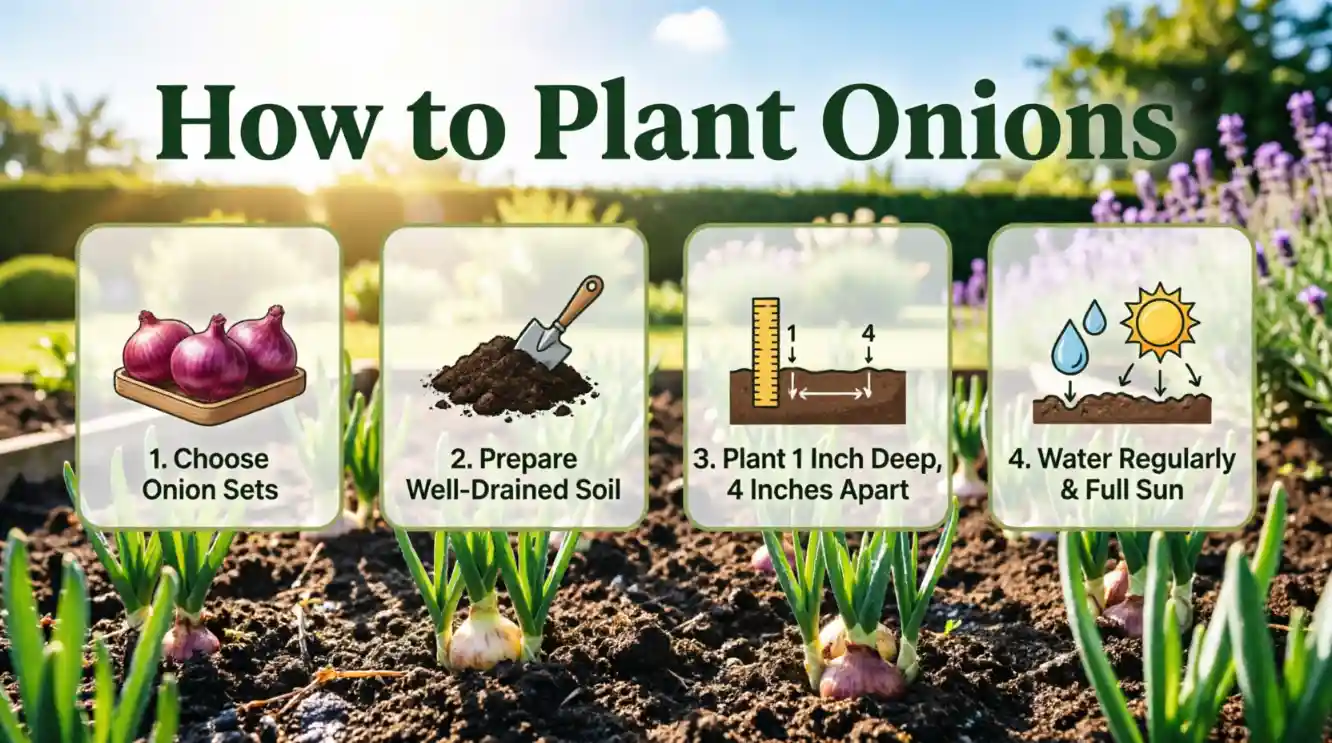
To plant onions, choose a sunny location with loose, well-drained soil and plenty of organic matter. Plant onion sets about 1–2 inches deep and 3–4 inches apart, or sow seeds about 1/4–1/2 inch deep. Keep the soil evenly moist, control weeds, and choose an onion variety suited to your region and day length.
Key Takeaways
- Onions grow best in full sun and well-drained soil.
- You can grow onions from seeds, sets, or transplants.
- Onion varieties need the right day length to form good bulbs.
- Onion sets are a simple choice for beginners.
- Keep onions evenly moist and the planting area free of weeds.
- Harvest when the tops naturally fall over and dry, then cure bulbs before storing.
Choose the Right Onion for Your Area
Before learning how to plant onions, choose a variety that matches your growing region.
This step matters because onions respond strongly to day length when they begin forming bulbs. Extension sources generally divide onions into short-day, intermediate-day, and long-day types. Short-day onions form bulbs with roughly 10–13 hours of daylight, intermediate-day onions with about 13–14 hours, and long-day onions with more than 14 hours.
In simple terms, a variety that performs well in the South may not produce the same results in the northern United States. Illinois Extension also notes that southern and northern onion varieties are not interchangeable because of their different day-length requirements.
So, check your seed packet or plant label for the recommended growing region before planting.
Choose How You Want to Plant Onions
You have three main choices: seeds, sets, or transplants.
Planting Onion Sets
Onion sets are small, immature bulbs. They are convenient because you skip the earliest seed-growing stage.
For beginners, sets are often an easy way to get started. Penn State Extension specifically recommends sets or transplants for novice gardeners.
Choose firm, healthy sets without mold or soft spots. Plant the pointed end upward.
Planting Onion Seeds
Seeds give you a wider choice of varieties, but they require more patience and attention.
For direct sowing, make shallow rows and plant seeds about 1/4 to 1/2 inch deep. Once seedlings emerge, thin them so they have enough room to develop. University of Minnesota Extension recommends rows about 12–18 inches apart and thinning seedlings to about 3–4 inches apart for bulb onions.
Planting Onion Transplants
Transplants are young onion plants that you move from a seed tray or nursery into the garden.
If you start onions indoors, allow roughly 9–12 weeks of growing time before transplanting, depending on the variety and production system. Harden seedlings before moving them permanently outdoors so they can adjust to outdoor conditions.
How to Prepare the Soil
Onions have shallow roots, so good soil preparation makes a noticeable difference.
Choose a location that receives full sun. Then loosen the soil and remove large rocks, weeds, and plant debris.
Onions prefer fertile, well-drained soil with good moisture-holding ability. Adding mature compost or other suitable organic matter can improve soil structure. Penn State lists a soil pH of about 5.8–6.6 for onion production, while specific recommendations can vary by location and soil type.
Avoid compacted soil. Bulbs need room to enlarge, and poorly drained conditions can create problems with root and bulb health.
If possible, have your soil tested before adding large amounts of fertilizer. That lets you correct actual nutrient deficiencies rather than guessing.
How to Plant Onion Sets Step by Step
If you are new to growing onions, sets provide one of the simplest planting methods.
Step 1: Pick the right location.
Choose a spot with full sun and good drainage.
Step 2: Prepare the soil.
Loosen the top layer and mix in suitable compost if needed. Remove weeds and large stones.
Step 3: Make planting holes.
Plant onion sets roughly 1–2 inches deep. The pointed end should face upward. Some gardening guidance recommends placing sets just below the soil surface with the tip showing.
Step 4: Leave enough space.
For larger bulb onions, a practical home-garden spacing is around 3–4 inches between plants, with approximately 12–18 inches between rows. Larger varieties may need more room.
Step 5: Water after planting.
Give the newly planted sets a thorough watering to settle the soil around them.
Step 6: Keep the area weed-free.
Onions do not compete well with weeds because of their shallow roots. Remove weeds early and carefully rather than waiting until they become large.
When Should You Plant Onions?
There is no single planting date for the entire United States.
Onions are cool-season vegetables, and planting time depends on your region, variety, and if you are growing from seeds, sets, or transplants. In many northern areas, onions are planted in early spring. Southern gardeners may plant certain onion types during fall or winter for a spring harvest.
For example, UGA guidance gives very different planting windows for southern and northern parts of the Southeast. That illustrates why local recommendations and the variety’s day-length classification matter more than a single nationwide date.
Best approach: check your local Extension planting calendar and the recommendations on your specific onion variety.
How to Care for Growing Onions
Watering
Onions have shallow roots, so they need consistent moisture while actively growing.
University of Minnesota Extension recommends thorough watering when rainfall does not provide enough moisture and notes that sandy soils may require more frequent watering. As bulbs reach full size and the tops begin falling, watering should be reduced or stopped.
Avoid constantly soggy soil. Your goal is moist, well-drained soil rather than standing water.
Weeding
Keep weeds under control throughout the growing season.
Because onion roots stay relatively shallow, weeds can compete for water, nutrients, and growing space. Use shallow hand weeding or cultivation around young plants to avoid damaging their roots.
A light mulch can also help reduce weed growth and conserve soil moisture.
Fertilizing
Do not automatically add large amounts of fertilizer.
Onion fertilizer needs depend on your soil, growing conditions, and production goal. A soil test can help determine what nutrients are actually needed. Penn State Extension recommends basing fertilizer applications on soil testing for onion production.
Also, avoid letting fertilizer touch the plants directly. Follow the fertilizer label and local Extension recommendations for application rates.
When to Harvest Onions
Your onions will tell you when they are approaching maturity.
For dry bulb onions, harvest generally begins when a substantial portion of the tops naturally fall over and dry. University of Minnesota recommends harvesting when about half the tops have fallen, while other extension guidance uses a broader range depending on variety and growing conditions.
Once mature:
- Loosen the bulbs carefully from the soil.
- Lift them without bruising or cutting the bulbs.
- Allow them to cure in a warm, dry, well-ventilated location.
- Store only properly dried, healthy bulbs.
Curing is especially important if you want onions to last in storage. Penn State notes that curing may take roughly two to four weeks depending on conditions.
Common Onion Planting Mistakes
Planting the wrong variety: A beautiful onion variety may still perform poorly if its day-length requirement does not match your region.
Planting too deeply: Onion bulbs need room to develop near the soil surface. Follow the recommended depth for your planting method.
Overcrowding plants: Give bulbs adequate space. Crowded onions generally have less room to enlarge.
Letting weeds take over: Young onions are poor competitors, so weed early and often.
Letting the soil dry completely: Shallow-rooted onions need regular moisture during active growth.
Harvesting too early: Give bulb onions enough time to mature unless you are intentionally growing them as green onions.
Skipping curing: Freshly harvested onions may not store well until their outer layers and necks have dried properly.
Frequently Asked Questions
How deep should onions be planted?
Plant onion sets are about 1–2 inches deep, with the pointed end facing upward. Onion seeds are much shallower and are generally sown about 1/4–1/2 inch deep. Always check your variety’s instructions because planting recommendations can vary.
How far apart should onions be planted?
For bulb onions, about 3–4 inches between plants and 12–18 inches between rows works well for many home gardens. Larger onions may need additional space. If you want smaller onions or are growing green onions, you can plant them more closely.
What is the best month to plant onions?
There is no single best month nationwide. In many northern areas, onions go into the garden in early spring, while some southern regions plant suitable varieties in fall or winter. Use your local planting calendar and select a variety suited to your area’s day length.
Do onions need full sun?
Yes. Onions grow best in full sun. Choose a location that receives plenty of direct sunlight and does not get shaded by taller vegetables, buildings, or trees.
How long do onions take to grow?
The growing period depends on the variety and if you start with seeds, sets, or transplants. As a general example, Gardeners’ World lists roughly 90–100 days from seed and around 80 days from sets, but local conditions and variety can change the timeline.
Conclusion
Learning how to plant onions is fairly simple once you understand the basics. Start with a variety suited to your region, give it full sun and loose, well-drained soil, and choose between seeds, sets, or transplants based on your experience and growing season.
For beginners, onion sets can make the process easier. Plant them at the proper depth and spacing, keep the soil consistently moist, and control weeds while the bulbs develop. Most importantly, do not rely on one planting date for every part of the country. Your local climate and onion variety matter.
With the right variety and a little regular care, you can grow fresh onions in a home garden and enjoy them straight from your own soil.

I am Jaxon Blake, the author of DreamZoons.com, where I explore the hidden meanings behind dreams. I am a dream expert, and I help people understand what their dreams may be trying to tell them.