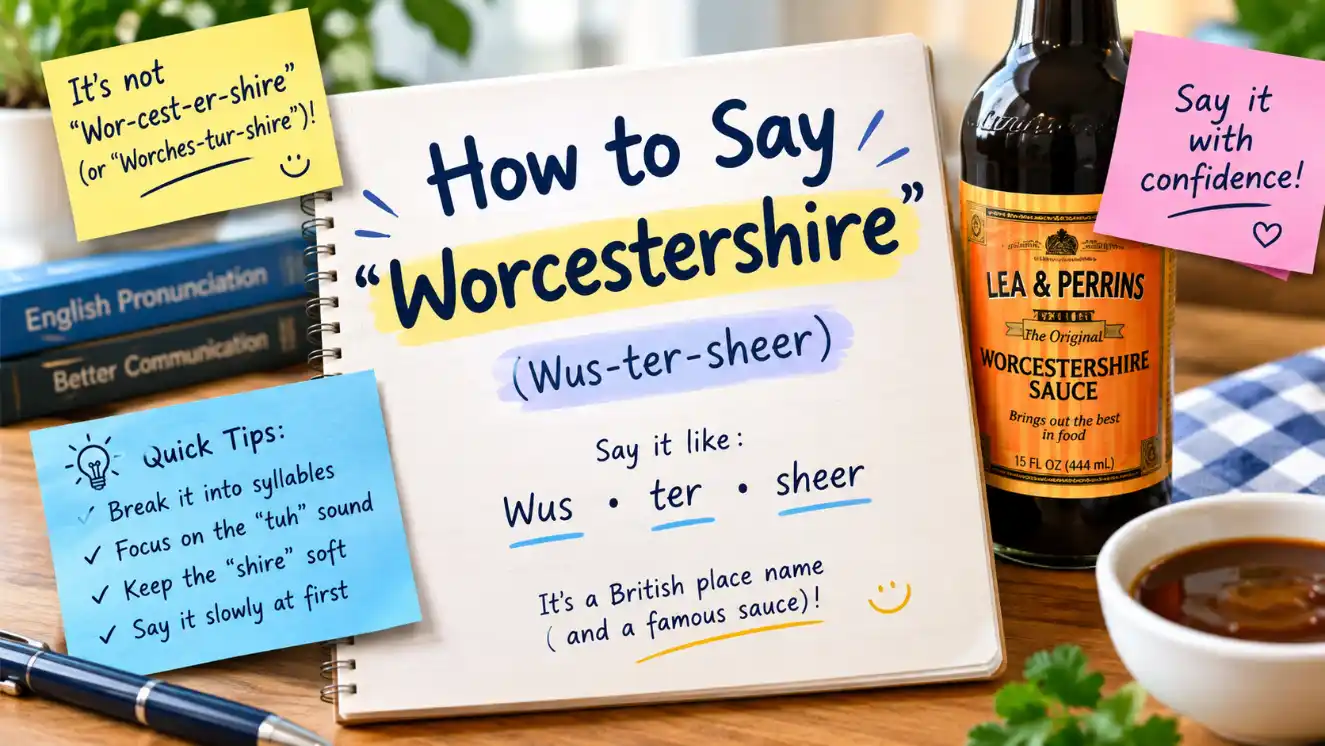
You’re standing in the condiment aisle, bottle in hand, and someone asks what you’re making for dinner. “Steak a little...” and then you freeze. Worcestershire sauce. You’ve read that word a hundred times, but you’ve never actually said it out loud in front of another human being. Is it “wor-CESS-ter-shy-er”? “War-chester-shire”? Something else entirely?
Here’s the good news: almost nobody gets this right on the first try, and there’s a very simple reason why. Worcestershire isn’t a word English speakers pronounce the way it’s spelled, it’s a word English speakers pronounce the way it sounds, which turns out to be far shorter and simpler than the spelling suggests. Once you understand the pattern behind it, you’ll never hesitate over that bottle again.
Let’s break it down, piece by piece.
The Quick Answer
If you just need the answer right now, here it is:
WUSS-ter-sher
Or, slightly closer to how it’s said in Britain:
WUSS-tuh-sher
That’s the whole word. Three syllables, not five. Say it fast, keep it relaxed, and don’t try to hit every letter you see in the spelling; most of them are just along for the ride.
Here’s the quick side-by-side so it sticks:
| What you see | What you say |
| Wor-ces-ter-shire | WUSS-ter-sher |
If you stop reading right now, you already know enough to order confidently at a restaurant or ask for it at the store. But if you’re curious why the word works this way and want to actually understand it instead of just memorizing it keep going.
Deep Phonetic Breakdown
To really lock this in, it helps to see the word broken into its actual sound units rather than its spelled-out letters.
IPA transcription:
- British (UK): /ˈwʊstəʃə/
- American approximation: /ˈwʊstərʃər/
Don’t worry if that notation looks intimidating; here’s the plain-English version.
Syllable by syllable:
| Segment | Sounds Like |
| Wor | “wuss” (rhymes with “puss”) |
| ces | mostly disappears blends into the next syllable |
| ter | “ter” (like the end of “master”) |
| shire | “sher” (rhymes with “her,” not “hire”) |
Put together, that’s WUSS-ter-sher with the stress landing on the first syllable, not spread evenly across the word the way the spelling might suggest.
Common mispronunciations, and why they happen:
- “Wor-cester-SHY-er” this treats “shire” like the word “hire,” which is a natural guess but incorrect. In this word, “shire” collapses down to “sher.”
- “War-chester-shire” swaps in a “ch” sound that doesn’t belong; the “ces” is soft, not hard.
- Pronouncing every syllable distinctly is the biggest giveaway of a non-native attempt. Native speakers compress the middle of the word almost automatically.
The core rule to remember: the more letters a British place name has, the more likely several of them are silent or absorbed into a neighboring sound. Worcestershire is really just an extreme example of a very consistent pattern which is exactly what the next section explains.
The Etymology Deep Dive
To understand why Worcestershire sounds nothing like it looks, you have to go back centuries to Old English, Latin, and the way English place names evolved.
Breaking down the name:
“Worcestershire” is actually two parts fused together: Worcester (the city) + -shire (meaning “county” or “district”). So Worcestershire literally means “the county of Worcester” , the same pattern behind Yorkshire, Hampshire, Lancashire, and Cheshire.
Where “-shire” comes from:
The suffix traces back to the Old English word scir, meaning an administrative district or area of authority. Over time, “scir” softened in pronunciation to “sher” which is exactly the sound that survives today, even though the spelling “shire” never caught up.
Why “-cester” compresses so aggressively:
The “-cester” ending comes from the Latin castra, meaning “camp” or “fort” , a leftover from Roman military settlements across Britain. As the word passed through Old English and Middle English, everyday speech wore down the middle syllables, a process linguists call elision. The spelling froze in place centuries ago, but the spoken word kept evolving, which is why “cester” now sounds like little more than “ster.”
The wider pattern:
Once you know this, other British place names suddenly make sense:
- Leicester → LES-ter
- Gloucester → GLOS-ter
- Cirencester → SY-ren-ster
- Towcester → TOH-ster
Worcestershire isn’t an outlier, it’s just one of the most extreme examples of a pattern baked into English place names for over a thousand years.
Regional & Dialect Variation
Pronunciation of Worcestershire isn’t perfectly uniform; it shifts depending on where you are and who’s saying it.
British English (Received Pronunciation):
In standard British English, the word is clipped and efficient: WUSS-tuh-sher. The final syllable is soft and almost swallowed, closer to “shuh” than a fully pronounced “sher.” British speakers tend to say the whole word in one smooth breath, without pausing between syllables.
American English:
Americans typically stretch the word slightly more, landing on WUSS-ter-sher with a more pronounced “r” sound throughout a natural result of American English being generally more rhotic (meaning Americans pronounce “r” sounds more distinctly than British speakers do). This version is completely acceptable and widely used, even if it’s not a perfect match for the British original.
Locals in Worcester, England:
Interestingly, people who actually live in Worcester tend to say the county name even faster and more clipped than outsiders expect, sometimes compressing it to something close to “WUSS-tuh-sha,” with barely any separation between the final syllables at all.
Why the variation is fine:
Unlike some pronunciation debates, there’s no need to stress over “correct” here. Both British and American versions are understood everywhere the sauce is sold, and neither will get you corrected in a restaurant or grocery store. The goal isn’t a perfect imitation of a Worcester local, it’s simply avoiding the five-syllable, letter-by-letter version that gives away that you’ve only ever seen the word written down.
Spelling vs. Sound: Why English Does This
Worcestershire feels like a trick question, but it’s actually a symptom of something much bigger: English spelling and English pronunciation stopped moving together centuries ago, and they never fully reconciled.
A language built from layers:
Modern English is a patchwork of Old English, Old Norse, Norman French, and Latin, all stacked on top of each other over roughly 1,500 years. Each layer brought its own spelling conventions, sound patterns, and quirks. Words absorbed from Latin and French often kept their original spelling long after English speakers changed how they said them aloud.
Printing froze the spelling but not the sound:
Once the printing press arrived in the 15th century, spelling began to standardize and lock into place. Pronunciation, however, kept evolving the way spoken language always does. The result: words like Worcestershire got their spelling “frozen” at one point in history, while the spoken version kept drifting further away from it.
Place names are the worst offenders:
Place names are especially prone to this gap because they’re often extremely old, rarely questioned, and passed down orally within communities long before anyone worried about consistent spelling. Locals just said the name the way it had always been said while the written form stayed anchored to an older version.
Worcestershire isn’t alone:
Edinburgh (“ED-in-bruh”), Leicester (“LES-ter”), and Featherstonehaugh (“FAN-shaw,” believe it or not) all suffer from the same disconnect proof that English spelling was never designed to be a reliable pronunciation guide.
The Sauce Itself: A Brief History
Before Worcestershire became a pronunciation puzzle, it was and still is one of the most widely used condiments in the world.
An accidental invention:
The sauce was created in the 1830s in Worcester, England, by two chemists, John Wheeley Lea and William Henry Perrins. According to the popular (if hard-to-verify) legend, a local nobleman asked the pair to recreate a spiced sauce he’d encountered while traveling in India. Their first attempt tasted so unpleasant that they stored the barrel away in a cellar and forgot about it. Months later, out of curiosity, they tasted it again and discovered that fermentation had transformed it into something rich, tangy, and completely unlike anything else on the market.
The name behind the name:
Lea and Perrins began bottling and selling the sauce commercially, and their names remain on every bottle to this day “Lea & Perrins” is still the standard label used worldwide.
What’s actually inside:
Traditional Worcestershire sauce is built from a distinctive blend: vinegar, molasses, anchovies, tamarind extract, garlic, onions, and a mix of spices, left to ferment for months. The anchovies give it a deep umami base, while the tamarind and vinegar provide the sharp tang the sauce is known for.
A global pantry staple:
From steak marinades and shepherd’s pie to Bloody Marys and Caesar dressing, Worcestershire sauce has become a quiet workhorse in kitchens far beyond England proof that a product can outlive the confusion over how to say its name.
Practical Pronunciation Drills
Understanding the theory is useful, but pronunciation ultimately comes down to muscle memory. Here’s a simple way to build confidence with the word.
Step 1: Say it slow, then speed up
Start deliberately, then gradually compress it:
- “Woo-ster-sheer” (too literal this is your starting point, not your goal)
- “Wuss-ter-sher” (getting closer)
- “Wuss-tuh-sher” (natural, fluent)
Repeat step three five or six times until it stops feeling foreign in your mouth.
Step 2: Use a mnemonic
A simple memory trick: think of the phrase “Wuss, ter, sher” as three quick beats almost like a tiny chant. Some people find it helps to imagine they’re saying “worcester” (WUSS-ter) the same way they’d say “rooster,” then just tacking “-sher” onto the end.
Step 3: Practice it in context
Isolated words are harder to remember than words used in real sentences. Try saying these aloud:
- “Can you pass the Worcestershire sauce?”
- “This marinade needs a splash of Worcestershire.”
- “I always forget how to say Worcestershire.”
Saying it inside a full sentence forces natural speech rhythm, which is often what makes the compressed pronunciation click.
Step 4: Say it fast, on purpose
Ironically, saying the word quickly is often easier than saying it slowly and carefully. Slow speech tends to over-articulate each syllable; fast, casual speech naturally blends them the way native speakers do.
By the end of a few rounds of practice, “Worcestershire” should feel less like a spelling test and more like a word you already know.
Cultural Moments: A Word That Trips Up Everyone
Worcestershire has become something of a linguistic rite of passage, a word so consistently mispronounced that getting it right almost feels like a small personal victory.
A recurring moment on cooking shows:
Food television has turned Worcestershire into an unofficial test of culinary credibility. Home cooks and even some professional chefs have stumbled over it on camera, often laughing it off mid-sentence rather than committing fully to a pronunciation. That moment of hesitation has become so familiar that audiences half-expect it whenever the sauce comes up in a recipe.
A staple of “hardest words to pronounce” lists:
Worcestershire routinely appears alongside words like “quinoa,” “espresso,” and “Beaujolais” on lists of commonly mispronounced words. Unlike those words, though, Worcestershire’s difficulty comes almost entirely from its spelling rather than any unfamiliar sound which is part of what makes it such a popular example.
A quiet meme in food culture:
Online, it’s become something of an inside joke among home cooks: confidently listing off ingredients until reaching Worcestershire, then either mumbling through it or substituting a vague gesture toward the bottle instead of saying the word aloud.
A shared, low-stakes struggle:
What makes Worcestershire different from most “hard” words is that mispronouncing it carries almost no real social cost; everyone understands what you mean, and most people have fumbled it themselves at some point. That shared experience is part of why the word has stuck around as a lighthearted talking point rather than a genuine barrier.
Conclusion:
Worcestershire looks like a word designed to trip you up, but as you’ve seen, the confusion comes entirely from spelling not from any real complexity in how it’s said. Once you understand where the word comes from and how English place names typically compress, “WUSS-ter-sher” starts to feel obvious rather than intimidating.
So the next time you’re reaching for that bottle in the grocery aisle, or asking for it at a restaurant, you don’t need to hesitate, mumble, or point instead of speaking. Say it plainly, say it quickly, and trust the pronunciation you’ve just learned.
You’re not alone in having struggled with this word nearly everyone has. The difference now is that you know exactly why, and exactly how to say it right.
Got a word that trips you up the way Worcestershire once did? You’re in good company drop it in the comments.

I am Jaxon Blake, the author of DreamZoons.com, where I explore the hidden meanings behind dreams. I am a dream expert, and I help people understand what their dreams may be trying to tell them.