How long does it take to learn a new language? For an English speaker, it can take several months to reach basic communication and one to several years to reach strong independent or professional ability. The timeline depends on the language, your goal, previous experience, study time, learning method, and how often you use the language.
Key Takeaways
- There is no single timeline for learning a new language.
- Basic communication can come much sooner than advanced fluency.
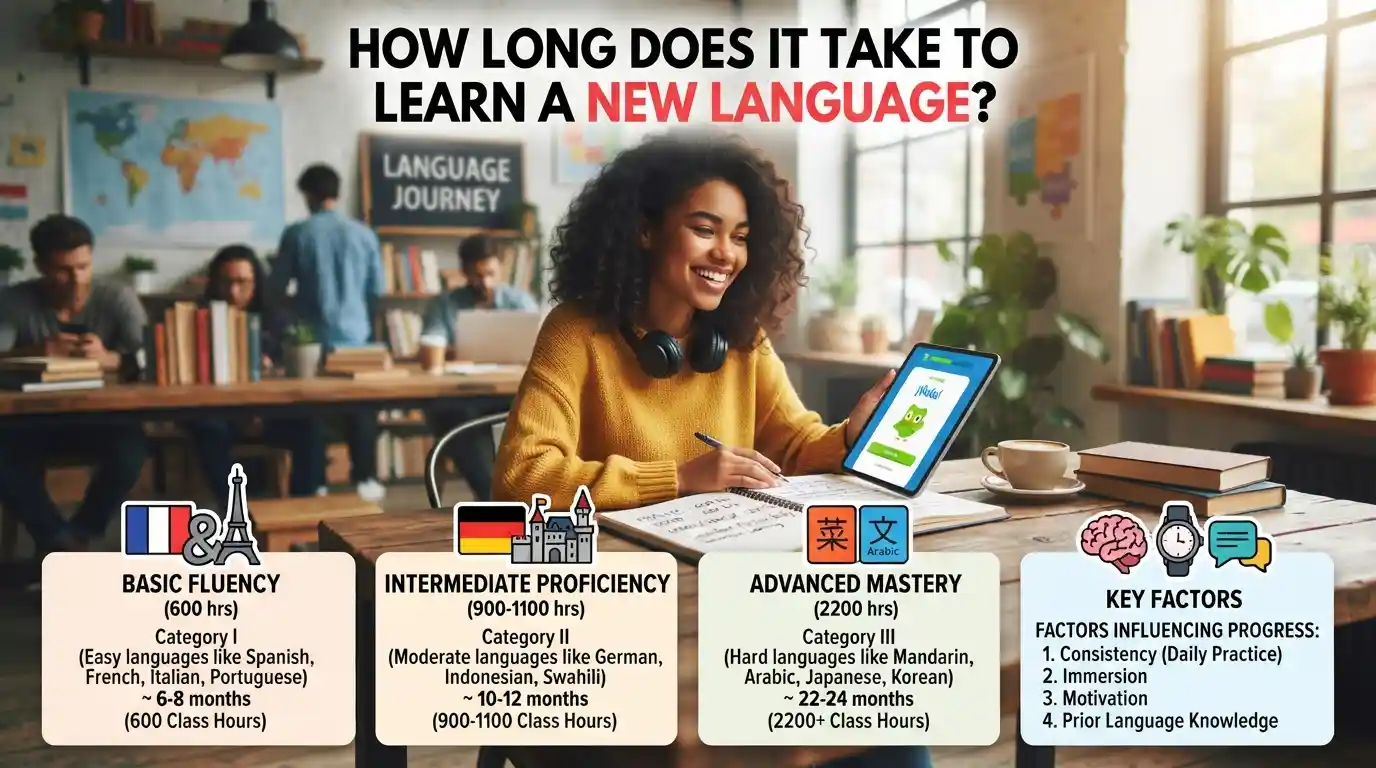
- The U.S. Foreign Service Institute estimates about 600–750 class hours for several languages relatively close to English and about 2,200 hours for Arabic, Mandarin Chinese, Japanese, and Korean in its intensive training context.
- Studying consistently every day is usually more useful than cramming for several hours once a week.
- Your goal matters: ordering food, having everyday conversations, and working professionally require different levels of ability.
What Does “Learn a Language” Actually Mean?
Before asking how long it takes, define what “learn” means to you.
Someone who wants to travel may only need basic phrases, directions, numbers, and common questions. Another learner may want to discuss complex subjects with native speakers or use the language at work. Those goals require very different amounts of practice.
The CEFR, or Common European Framework of Reference for Languages, describes proficiency through six main levels: A1, A2, B1, B2, C1, and C2. These levels focus on what a person can actually do with a language rather than simply counting vocabulary words or grammar rules.
Basic Language Skills
At A1, you can handle very simple expressions and personal information. At A2, you can manage routine conversations involving familiar subjects such as shopping, family, work, or daily activities.
With regular practice, many learners can begin using basic language within months rather than waiting years.
Conversational Ability
At B1, you can understand the main points of clear speech about familiar subjects and deal with many situations while traveling. At B2, you can interact with greater fluency and communicate more comfortably with native speakers.
For many people, this is what they really mean when they say they want to “learn” a language.
Advanced or Professional Fluency
C1 and C2 represent much stronger proficiency. At C1, learners can communicate flexibly for social, academic, and professional purposes. C2 involves understanding almost everything heard or read and expressing ideas with a high degree of precision.
That level can take years of sustained use.
How Many Hours Does It Take to Learn a New Language?
One useful benchmark comes from the U.S. Department of State’s Foreign Service Institute (FSI). Its estimates are based on intensive training for English-speaking diplomats and describe the typical classroom hours needed to reach professional working proficiency. The Department also notes that actual learning time varies according to factors such as prior language experience, aptitude, and time spent in class.
| Language group for English speakers | Approximate class hours | Examples |
| Category I | 600–750 | Spanish, French, Italian, Portuguese |
| Category II | About 900 | German, Indonesian, Swahili |
| Category III | About 1,100 | Hindi, Russian, Turkish, Vietnamese |
| Category IV | About 2,200 | Arabic, Mandarin Chinese, Japanese, Korean |
These numbers are benchmarks, not promises. FSI students study intensively in a structured environment, so a person studying casually for a few hours each week should not expect the same calendar timeline.
Cambridge English also emphasizes that there is no universal number of hours because progress depends on the learner’s goal, motivation, opportunities, background, and learning conditions. Its research suggests that motivated adult learners often need roughly 100–200 guided learning hours to move from one CEFR level to the next, although the exact amount varies by level and learner.
How Long Does It Take at Different Study Speeds?
Your weekly schedule can change the calendar time dramatically.
Imagine that you need 600 focused hours as a rough benchmark for a particular language and goal:
| Study time | Approximate time to reach 600 hours |
| 30 minutes a day | About 3.3 years |
| 1 hour a day | About 1.6 years |
| 2 hours a day | About 10 months |
| 10 hours a week | About 14 months |
| 15 hours a week | About 9 months |
These are simple calculations, not guaranteed learning timelines. The type of practice matters just as much as the number of hours.
For example, one hour of active speaking, listening, reading, and review can be more useful than one hour of passively scrolling through vocabulary cards.
How Long Does It Take to Learn Different Languages?
Language difficulty matters because languages differ in vocabulary, grammar, writing systems, pronunciation, and their distance from English.
Spanish and French
Spanish, French, Italian, Portuguese, and several other languages fall into FSI Category I for English speakers. FSI estimates roughly 600–750 class hours for its professional-working-proficiency target.
If you study one hour every day, that amount of classroom time alone would equal roughly 1.6–2 years. However, your personal path could be shorter or longer because self-study, conversation, immersion, previous knowledge, and learning quality all change the equation.
German
German is listed in Category II at approximately 900 class hours in the FSI framework.
For an English speaker, some vocabulary may feel familiar, but pronunciation, grammar, word order, and noun cases can create additional challenges.
Arabic, Mandarin, Japanese, and Korean
The FSI places Arabic, Mandarin Chinese, Japanese, and Korean in its highest difficulty category, with about 2,200 class hours in its intensive training model.
These figures do not mean you need 2,200 hours before you can say anything useful. You can learn greetings, common expressions, and simple conversations much earlier. The larger figure relates to reaching a much higher professional proficiency target.
What Affects How Fast You Learn?
Two people can study the same language for the same number of months and make very different progress.
Your Previous Language Experience
If you already know another language that shares vocabulary or grammar with your new target language, you may recognize patterns more quickly.
For example, someone who already speaks one Romance language may find some parts of another Romance language more familiar than someone starting from English alone.
Similarity Between Languages
Language distance matters. An English speaker and a Spanish learner may encounter more familiar vocabulary than an English speaker learning Japanese.
The FSI categories reflect these differences for English-speaking learners, although they should not be treated as an exact prediction for every individual.
Quality and Consistency of Practice
Consistency is important. Studying for 30 minutes every day gives you frequent contact with the language.
Instead of spending five hours on one weekend day, you might divide that time across the week. This gives you more opportunities to review vocabulary, hear pronunciation, practice grammar, and use new expressions.
Immersion and Real-Life Use
Language becomes more meaningful when you use it for real communication.
Try listening to beginner-friendly content, reading simple material, writing short messages, and speaking with other learners or native speakers. As your skills improve, increase the amount of authentic language you consume.
Can You Learn a Language in 3 Months?
Yes, but define what “learn” means.
Three months can be enough to build a useful foundation if you study consistently. You may learn greetings, essential vocabulary, basic grammar, common questions, and simple conversations.
However, becoming highly fluent in three months is a very different goal. A learner studying casually for 30 minutes a day will have a very different experience from someone studying several hours every day in an intensive program.
So rather than asking, “Can I become fluent in three months?” ask, “What can I realistically do in this language after three months?”
That question gives you a much more useful target.
Can You Become Fluent in One Year?
You can make substantial progress in one year, especially with a clear goal and consistent practice.
However, “fluent” has no single universal definition. A person might comfortably handle everyday conversations but still struggle with academic writing, fast native speech, humor, or specialized vocabulary.
A better one-year goal could be:
“By this time next year, I want to hold a 30-minute conversation about everyday topics without constantly translating in my head.”
That goal is specific, measurable, and easier to build a study plan around.
How to Learn a New Language Faster
Set a Specific Goal
Choose a practical target. Maybe you want to travel, speak with family, study abroad, communicate at work, or understand movies.
Your goal determines what you should practice most.
Practice All Four Skills
Do not focus only on vocabulary apps.
Build a balanced routine with:
- Listening: Hear natural language regularly.
- Speaking: Practice producing sentences.
- Reading: Read material appropriate for your level.
- Writing: Create short messages, notes, or journal entries.
Use the Language Every Day
Even a short daily session keeps the language active in your mind.
You could spend 15 minutes reviewing vocabulary, 15 minutes listening, and 15 minutes speaking or writing. As your schedule allows, increase the time.
Start Speaking Early
You do not need perfect grammar before you speak.
Start with simple sentences. Make mistakes, notice them, and try again. Real communication helps you discover which words and structures you actually need.
Frequently Asked Questions
How long does it take to become conversational?
For many learners, basic conversation can begin within a few months of consistent practice, but reaching comfortable independent conversation can take much longer. Your language, previous experience, weekly study time, and definition of “conversational” all matter.
Is 30 minutes a day enough to learn a language?
Yes. Thirty minutes a day gives you regular exposure and adds up to more than 180 hours over a year. Progress will usually be slower than with one or two hours a day, but consistent practice can still build useful skills.
What is the fastest way to learn a language?
Use a focused combination of listening, speaking, reading, vocabulary review, and feedback. Set a specific goal and practice regularly. Real conversations and understandable input can help you connect vocabulary and grammar with actual communication.
Can I become fluent in a language in a year?
It is possible to make major progress in a year, but there is no universal guarantee of fluency. Intensive study, language similarity, prior experience, immersion, and your definition of fluency all affect the result. A measurable skill-based goal is more useful than a vague deadline.
Conclusion
So, how long does it take to learn a new language? The honest answer is that it depends.
You might learn basic phrases within weeks, begin simple conversations within a few months, and need one or more years to develop strong independent skills. Professional-level ability can require considerably more time, especially when the language differs greatly from English.
The FSI provides useful benchmarks, ranging from about 600–750 class hours for several languages closer to English to around 2,200 hours for languages in its highest difficulty category.
Instead of chasing an exact number of months, choose a clear goal, track your actual study hours, and use the language regularly. Small sessions repeated consistently can turn into substantial progress over time.

I am Jaxon Blake, the author of DreamZoons.com, where I explore the hidden meanings behind dreams. I am a dream expert, and I help people understand what their dreams may be trying to tell them.